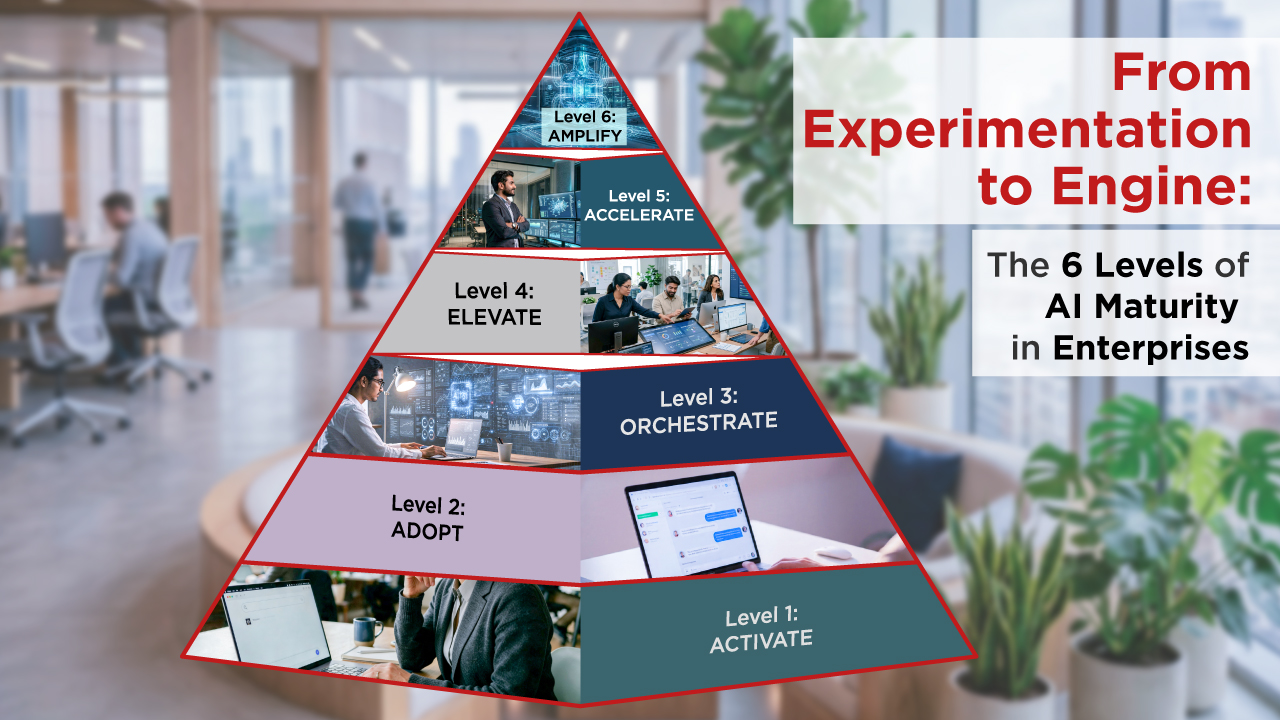
Artificial Intelligence has moved from curiosity to capability. Yet most enterprises are still operating in fragmented, inconsistent ways. Teams experiment. Individuals explore. But very few organizations translate this energy into a structured, scalable system that delivers measurable value.
The real gap is not access to AI. It is maturity.
Enterprises must have a clear lens to comprehend this. The 6 AI maturity levels offer that prism. They chart the process by which organizations develop from an isolated application to compounding, system-driven intelligence.
Level 1: ACTIVATE: AI as a Search Bar
Activation begins with curiosity, not capability. It is the moment AI enters awareness, but not yet behavior. At this stage, the goal is simple: turn AI “on” in people's minds, even if its use remains basic.
At this point, AI is being considered as an advanced search engine. The use is reactive and irregular. Employees pose singular questions and proceed. The continuity, the memory, and the integration into the real work are lacking.
This is where most organizations start. It generates awareness but not value. At this stage, AI is seen as an optional tool rather than a core part of how work gets done. As a result, the impact remains surface-level, failing to drive meaningful change or improvement.
Level 2: ADOPT: AI as an Assistant
Adoption moves AI from curiosity to habit. It introduces structure, but not yet transformation. Here, individuals begin to rely on AI, but mostly within isolated tasks rather than integrated systems.
In this case, employees begin to use prompts and templates. Their interaction with AI follows a pattern. Nonetheless, the outputs do not relate to workflows. AI is useful for producing content, but it does not affect choices or delivery.
This is another area where most organizations fail. Activity is enhanced, and impact is not. AI can boost productivity for individuals, but it rarely connects to decision-making or business outcomes. Without integration into core processes, the benefits remain isolated and shallow.
Level 3: ORCHESTRATE: AI as a Teammate
Orchestration is where AI starts to work *with* people, not just *for* them. It introduces rhythm, iteration, and connection. The focus shifts from one-off outputs to continuous collaboration between human thinking and machine support.
Now, AI is part of the working day. Participants retain context between sessions. They loop, sharpen, and link outputs to real deliverables.
This change is the initial significant one. AI is beginning to add value to productivity. Nonetheless, the power remains individual. It is nonexistent, repeatable, and scalable to teams. Organizations see pockets of success, but knowledge sharing and best practices are still ad hoc. Without a framework for collaboration, the full potential of AI is left untapped at the team level.
Level 5: ELEVATE: AI as the Operating System
Elevation transforms AI from a tool into infrastructure. It becomes embedded in how work flows, not just how tasks are done. Consistency replaces experimentation, and systems begin to shape behavior across teams.
This is the turning point. AI is not just an individual application; it is a team-level approach. Shared playbooks emerge. Formats of output are standardized. AI is integrated into the workflows, sprint cycles, and review processes.
This level cannot be achieved only through training. It demands redesign. Normalizing the use of AI in delivery requires organizations to standardize and for managers to align teams. Systems, workflows, and expectations must be clearly defined and reinforced across the company. Success depends on cross-functional coordination and management's commitment to embedding AI into daily operations.
Level 5: ACCELERATE: AI as Autopilot
Acceleration is where speed meets structure. AI begins to move work forward with minimal human initiation and intervention. The emphasis shifts from doing tasks faster to redesigning how tasks are executed altogether.
Workflow automation occurs at this stage. Several AI agents work with task sequences. The role of man has changed to supervision.
The organizations start to achieve actual efficiency. There is increased speed and predictability in the processes, as well as reduced reliance on manual effort. Here, governance, tooling, and risk structures become critical. Continuous monitoring and optimization become part of routine operations. Human oversight focuses on exception handling and strategic improvements, rather than day-to-day task management.
Level 6: AMPLIFY: AI as the Engine
Amplification is where AI compounds value over time. Every interaction strengthens capability and expands intelligence. The organization no longer just uses AI; it grows through it.
This is the highest level of development. AI systems learn from usage. They improve over time. Knowledge builds up in an organization. Capability is an asset that does not have to increase in related increments in terms of effort or number of employees.
There are very few businesses with this level in modern times. Those who do so will define the competitive advantage over the next 10 years. Their AI systems not only adapt to change but also actively drive innovation and new business models. These organizations set the pace for entire industries, making it difficult for late adopters to catch up.
Why Most Enterprises Fail to Progress
It is not the difficulty of comprehending AI. It is operationalizing it.
Most organizations spend a lot on training and tools. However, they cannot go beyond Level 2-3. The reason is simple. They consider AI a skill issue rather than a system issue.
The absence of workflow integration, common practices, and leadership alignment makes AI a single layer. It does not remake the way work is done.
Upward development is done intentionally. The transition from Level 1 to Level 3 is a behavior change. The transition between Level 3 and 5 concerns system design. These are two entirely different problems.
The Role of VMI India
This is the gap that VMI India fills. It does not place AI as a tool to be embraced. It views AI as an operational capability that should be developed, quantified, and scaled.
The strategy starts with transparency. Businesses require a plausible foundation. VMI India employs behavioral measurement techniques grounded in real working situations. This prevents the pitfall of self-reported preparedness and provides a more accurate picture of the team's actual positions.
There, the object of attention is movement, but no longer consciousness. VMI India plans transitions between levels. In the case of early stages, this involves legal habit formation and workflow integration. At higher levels, the work extends to team playbooks, governance models, and the system's architecture.
One distinguishing feature is the focus on integrating AI into delivery. This implies adopting AI in sprint rituals, decision-making processes, and output quality. This is not aimed at higher usage. The aim is to achieve quality, uniform results.
VMI India is also concerned with the obstacles that hinder progress. These are skill gaps, the absence of tools, inappropriate alignment of work processes, and organizational reluctance. Identifying and addressing these restraints makes inter-level movement measurable and actionable.
At more advanced stages of maturity, VMI India assists the organization in developing automated and agent-based workflows. It allows converting the manual implementation to exception-based monitoring. In the long run, the result is the formation of learning, adapting, and improving systems.
Moving Forward
The AI maturity is not a straight adoption process. It is an arranged advancement of competence.
Businesses that are still in the experimentation phase will not experience high returns. Those who invest in design, workflow integration, and organizational alignment will unlock compounding value.
These two outcomes do not differ in terms of technology. It is purpose, organization, and performance. Leaving experimentation and going to the engine is no longer optional. It is the paradigm shift that will distinguish between organizations operated with AI and those built on it.