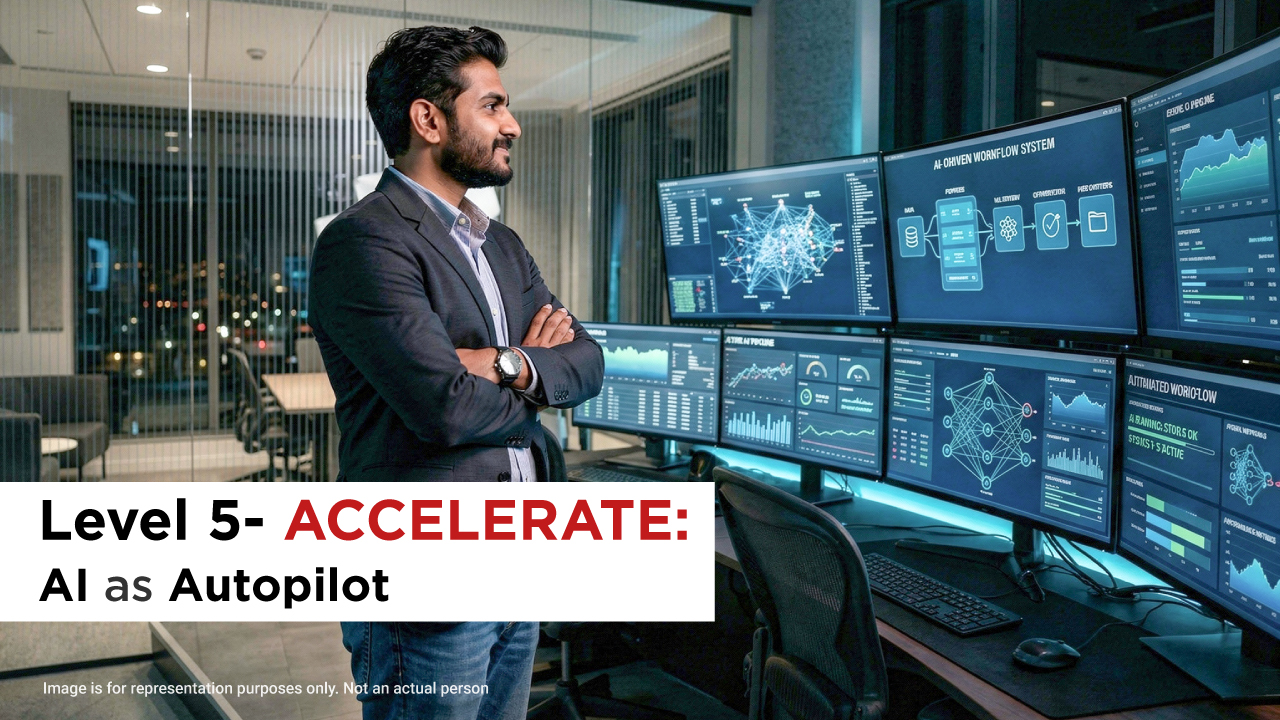
When Workflows Become Automated & Human Roles Shift Toward Oversight
At this stage, the role of AI changes completely.
AI is no longer integrated only to support execution.
It begins with driving execution itself.
This is Level 5.
AI moves from being part of workflows to orchestrating workflows. Tasks are no longer completed manually, one step at a time. Instead, connected systems and AI agents automatically manage sequences of work, transferring outputs from one stage to the next.
Human involvement does not disappear.
It evolves.
Employees spend less time executing work directly and more time supervising systems, monitoring quality, and managing outcomes.
What Level 5 Looks Like Across Indian Enterprises
In Level 5 environments, workflows become automated end-to-end.
Marketing campaigns are no longer managed entirely by manual teams. AI systems generate strategic inputs, create content variations, optimize messaging, analyze performance, and automatically prepare reports.
Product development workflows are no longer dependent on disconnected tools and manual coordination. AI systems organize documentation, track execution, identify bottlenecks, and surface operational risks.
Systems begin running workflows.
Tasks are triggered automatically. Outputs move between systems without constant human involvement. Processes become more predictable and continuous.
Teams spend less time on repetitive operational tasks and more time focusing on measurement, strategy, exceptions, and optimization.
This creates a different operating model.
Execution becomes continuous.
Across India’s rapidly digitizing industries, such as IT services, fintech, SaaS, banking, manufacturing, logistics, healthcare, and customer operations, this level represents a major competitive advantage.
Organizations can handle increasing scale without proportionally increasing workforce complexity.
The Shift from Doing Work to Supervising Systems
Level 5 introduces a major shift in human responsibility.
In earlier stages, employees were primarily responsible for creating outputs.
At this stage, their role changes.
Employees become responsible for ensuring quality, accuracy, alignment, and system performance.
Work is no longer centered only on execution.
It becomes centered on oversight.
This requires an entirely different set of capabilities.
Teams must understand how systems operate, where workflows may fail, and when human intervention becomes necessary. Employees must learn how to evaluate outputs, manage exceptions, and make strategic decisions rather than manually complete every process.
Organizations that fail to prepare for this transition often struggle.
Because at Level 5, the challenge is no longer productivity.
It becomes control.
Why This Level Creates Exponential Efficiency
Level 5 is when organizations begin to experience exponential operational gains.
Automation reduces repetitive manual effort. Processes move faster. Output volume increases without requiring proportional increases in headcount.
However, the greatest advantage is predictability.
When workflows become system-driven, variation decreases. Errors become easier to identify. Performance becomes measurable across functions and delivery systems.
This creates operational stability.
Organizations can scale without constantly increasing complexity. Teams manage higher workloads without becoming overextended. Leadership gains real-time visibility into how workflows and systems are performing.
AI stops functioning as a productivity tool.
It becomes an efficiency engine.
The Risks Introduced by Autopilot Systems
This stage also introduces new organizational risks.
When systems begin operating autonomously, mistakes can scale very quickly.
A flawed input can affect an entire workflow. A poorly aligned objective can generate large volumes of incorrect outputs at speed.
Without governance, automation becomes dangerous.
Organizations must establish:
Control systems to monitor quality and outputs.
Intervention points where humans can step into workflows when required.
Feedback mechanisms that continuously improve system performance.
Trust in AI must always be balanced with oversight.
Level 5 is not about removing human involvement.
It is about redefining human contribution.
What Still Needs to Evolve
Even with advanced automation, several capabilities are still developing:
Learning Systems: Workflows do not yet improve themselves independently.
Adaptive Intelligence: Systems still require human updates, supervision, and optimization.
Strategic Innovation: AI can drive execution, but it does not independently create long-term strategic direction.
This is why Level 5 is powerful, but not yet complete.
The system operates efficiently.
But it does not fully evolve on its own.
The Role of VMI India
At Level 5, the organizational challenge shifts once again.
The focus is no longer on building systems.
The focus becomes managing intelligent systems responsibly.
VMI India is assisting organizations in making a seamless shift from isolated AI workflows to connected AI-powered ecosystems. The first is to determine which processes are mature enough for automation and which need further standardization.
Not all workflows are best suited for automation right away.
Precision matters.
After identifying the opportunities, VMI India can help organizations design multi-agent systems that can execute multiple task sequences across workflows. Such systems are designed to support the business objectives, operational priorities, and delivery expectations and are not simply ‘automated for the sake of it'.
Governance is a key issue at this point.
VMI India establishes monitoring mechanisms that outline the monitoring process, when human intervention is needed, and how risks associated with operations are managed. This way, automation will be reliable, measurable, and accountable.
There is also an incorporation of measurement frameworks.
Organizations can become aware of what they can do more efficiently, how often mistakes occur, how well their operations are performing, and the results of their workflows. This provides ongoing improvements based on actual operational data.
VMI India is also committed to workforce transition.
Staff members receive training in managing systems, interpreting AI output, handling exceptions, and making more valuable strategic decisions. Human capability grows and develops in tandem with technological capability.
The goal is simple.
Move organizations from execution to orchestration.
What Comes Next
At Level 5, AI has proven capable of executing workflows.
Running workflows is not the end of the line, though.
The next level is when systems begin to learn, adapt, and improve on their own. Knowledge compounds continuously. Capability is a development that does not require constant human guidance.
That’s where VMI India and Artificial Intelligence are the driving force of the business.