Imagine a student preparing for a months-long test to determine their academic future.
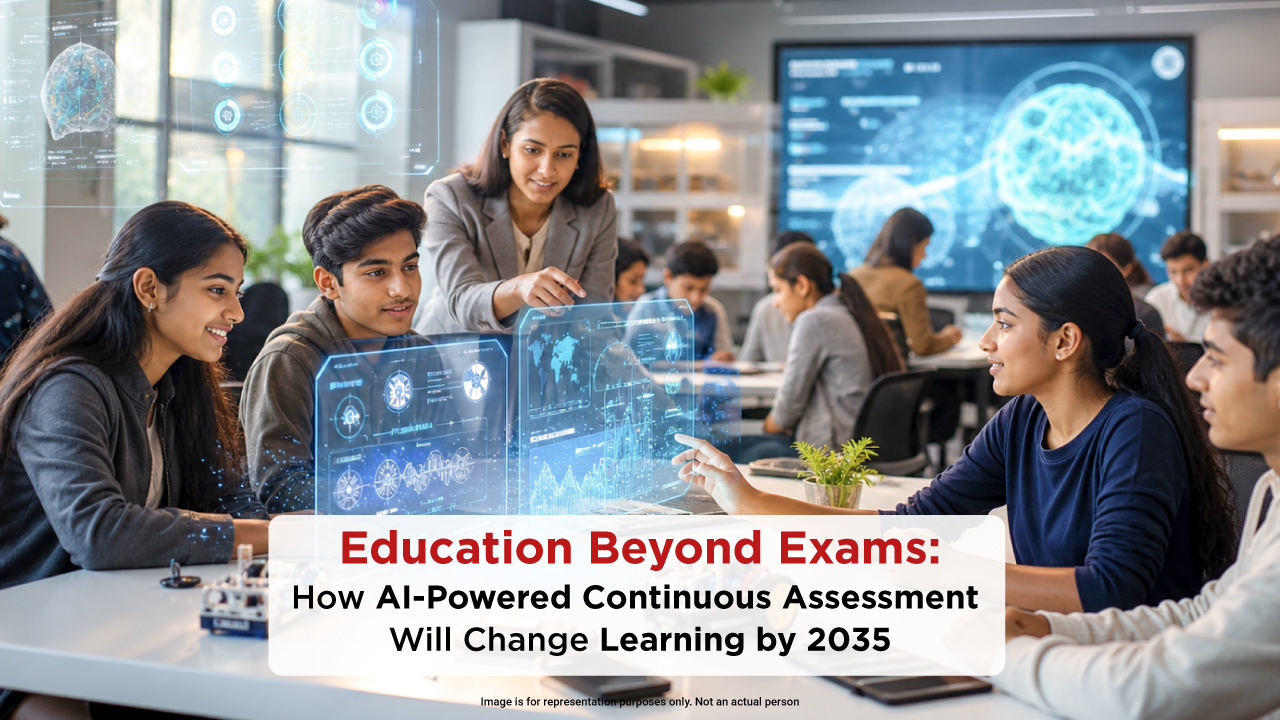
Now, envision another student working on real-world problems, interacting with other students, tackling projects, and getting feedback throughout the year. Which learner does a better job of presenting a true self?
In an ever-changing world, education is changing as well, and one key reality that schools and universities are starting to acknowledge is that learning is a process, not a time. In 2035, exams may not be the main way students are evaluated. Rather, ongoing evaluation, application, and insights from AI may change the nature of learning assessment.
Why Conventional Exams No Longer Reflect Real Student Potential
Examinations have been used to measure academic performance for over 100 years. They help promote consistency and scalability, but may involve testing recall of information under stress, which is different from the meaningful application of knowledge.
Employers and higher education institutions are looking for:
* Critical thinking
* Creativity
* Problem-solving
* Communication
* Collaboration
* Adaptability
Unfortunately, these skills cannot be assessed in one summative test.
Consequently, teachers across the globe are investigating alternative assessment methods that are more closely aligned with authentic performance and long-term development.
The Rise of Continuous Assessment within Modern Education
The focus on continuous assessment moves from a one-off performance to a process of continuous development.
Teachers can assess learning, rather than at the end of the term, through:
* Project-based learning
* Simulations and case studies
* Classroom discussions
* Digital portfolios
* Collaborative assignments
* Reading prompts and suggestions to help with reading comprehension
This approach creates a more comprehensive picture of student progress while reducing the anxiety associated with high-stakes testing.
Students are evaluated on their knowledge and their ability to learn, adapt, and apply that knowledge over time.
How Artificial Intelligence Is Changing Student Assessment
Artificial intelligence is enabling large-scale, continuous assessment.
AI-powered systems can analyze learning patterns, identify knowledge gaps, track progress, and provide personalized feedback in real time.
Educators do not have to wait for annual exam results to see:
* Problem-solving approaches
* Learning behaviors
* Skill development trends
* Areas requiring intervention
* Student engagement levels
This enables institutions to provide proactive support for learners and enhance their learning experiences.
The Changing Role of Teachers in AI-Enabled Classrooms
The role of educators is changing as the shift to continuous assessment and evidence-based decision-making takes hold.
The teachers are becoming more:
* Learning facilitators
* Mentors and coaches
* Project guides
* Critical thinking facilitators
* Personalized learning advocates
Instead of investing hours in students' exam preparation, educators may invest time in students' thinking, problem-solving, and learning future-ready skills.
This leads to a classroom culture that emphasizes growth, curiosity, and meaningful learning experiences.
Why Universities & Employers Are Moving Toward Skills-Based Evaluation
Academic records and grades only convey a partial picture of a student's performance.
In 2035, universities and employers could be looking for more comprehensive learner profiles that demonstrate:
* Practical skills
* Creativity
* Leadership potential
* Teamwork capabilities
* Communication effectiveness
The ability to adjust in complex circumstances
These are more enriching and give a better picture of the individual's potential than standardized test scores.
Skills are required, not just evidence of memory.
The Future of Assessment: From Grades to Dynamic Learning Profiles
Prospective assessment systems will replace the conventional grading system.
Students can create their own dynamic digital portfolio that documents evidence of learning over time by:
* Projects
* Performance tasks
* Collaborative work
* Skill demonstrations
* Real-world challenges
These profiles will change as learners grow and develop, reflecting their learning progress and capabilities over time.
Assessment is not as obvious; it is more meaningful.
How VMI India Supports the Future of AI-Driven Assessment
Technology platforms are essential for supporting continuous assessment in educational institutions, preparing for the next generation of learning.
By implementing AI-driven assessment and learning analysis, VMI India empowers institutions to transcend the limitations of conventional examination systems.
Through intelligent assessment solutions, institutions can:
* Track student progress in real time
* Create adaptive learning experiences.
* Generate diverse assessment pathways.
* Measure skill development continuously.
* Build comprehensive learner profiles.
* Improve educational outcomes through data-driven insights.
VMI India gives teachers the freedom to learn about their students' thinking, problem-solving, sharing, and development through multiple exams.
This delivers a more comprehensive, precise, and future-oriented education.
Conclusion: The Future of Learning Is Continuous
Classrooms in 2035 will be very different from those of today.
Learning will be personalized. Assessment will be more formative. Demonstrating skills will be the method for determining success.
Technology will not supplant teachers; it will help the teacher better support each learner's journey.
With the changing dynamics of learning, the focus might no longer be on exam results, but on how well they learn, adapt, create, and contribute to their world.
In that future, continuous assessment will be much more useful than one test score.