When Maya walked out of her final examination, she felt a familiar but indescribable mix of emotions. Relief, certainly, but she also felt uncertainty. After months of studying, practicing questions, and rewriting late into the night, her efforts would now be represented by a single paper written under pressure. All the fatigue, anxiety, confidence, or luck she brought to that moment would be measured as ability.
Millions of students in their secondary schooling years across the globe are experiencing the same thing. High-stakes tests have served as markers of learning. They are effective, standardized, and comparable. Yet they, too, are hacking tools. They do not tell much about the learning process, the reasons a student has difficulties, and the ways he/she develops throughout his/her life.
Now that education systems around the world are starting to redefine the future of learning, one question continues to emerge: What would happen to learning if assessment did not stop it but served and nurtured it?
When Assessment Stops Being an Event
Conventionally, the assessment approach is scheduled, time-limited, and terminal. Studying precedes the examination; decision-making follows. Whenever it is received, the feedback is often too late to be of use.
This is a structure that AI is altering silently.
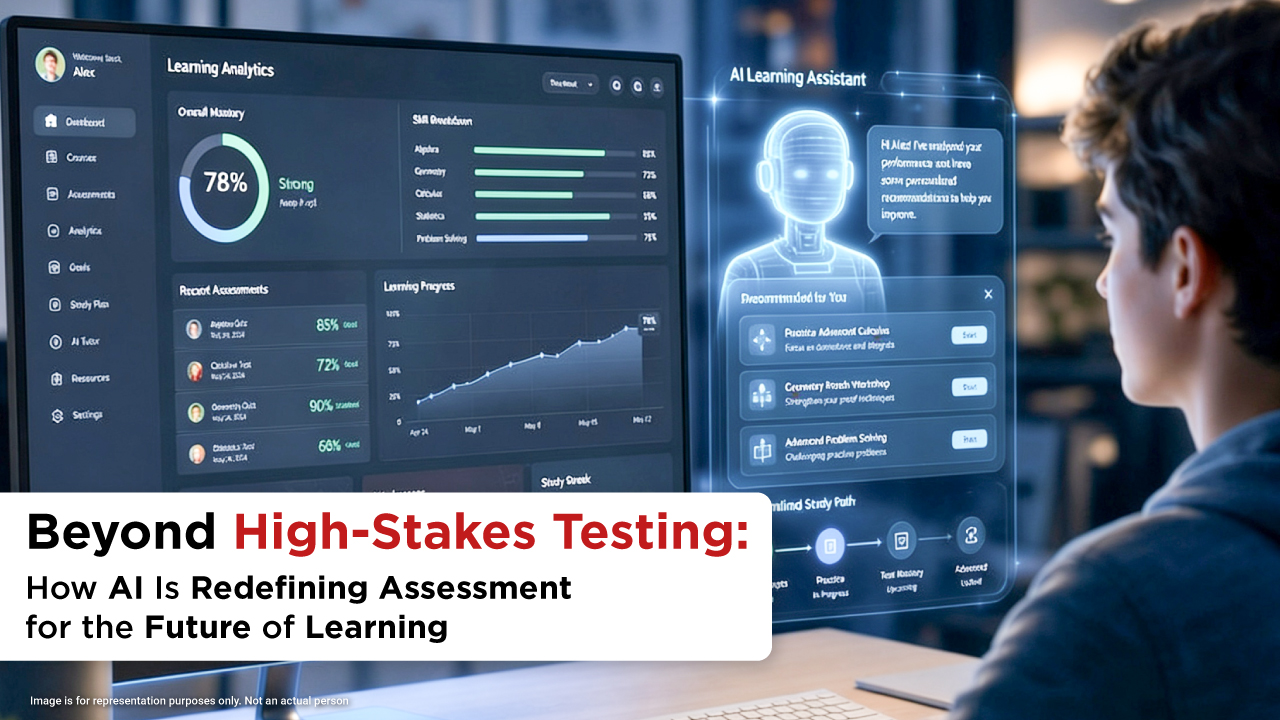
Consider that Maya studied her daily lessons. The assessment system notices, but does not judge, that she is solving problems, writing brief answers, or using concepts. It recognizes the patterns of her thought, monitors progress through concepts, and modulates difficulty in real time. It does not have test-day stress, since evaluation becomes part of learning.
This is an interruption-free assessment.
Curriculum-Aligned Intelligence, Not Guesswork
Among the most widely discussed fears of AI in education is misalignment: a tool that produces impressive results but becomes distorted in what students actually should learn. Assessment in the future requires the reverse.
Curriculum-based AI tests are constructed around learning objectives. All questions, activities, and problems are mapped to specific outcomes as outlined in the curriculum. This is to ensure that the assessment is grounded, rigorous, and relevant regardless of geography or system.
This translates to clarity among students. What they do, what they are examining, and what they are supposed to be good at are all saying the same thing. There are no surprises, no disconnection, no artificial intelligence that creates answers not covered in the learning objectives.
Why Promptless Matters
It is also essential to understand the way AI operates in the background.
There are numerous AI tools based on prompts that are explicit instructions that determine answer generation. Although climactic in the context of creativity, prompt-based systems introduce uncertainty into the evaluation process. The reactions may not be identical depending on the manner of expression, but not on comprehension.
Unscheduled AI evaluation systems are different.
They do not generate answers. They do not “improvise.” Rather, they compare learners' responses with predetermined competencies, concepts, and skill frameworks. It is not content production that is intelligent, but content interpretation.
For Maya, this means fairness. Her advancement is gauged by her performance- not in the cleverness of a question or the way AI understands a query. Evaluation is made uniform, dependable, and transparent.
From Judgment to Insight
With the transition of evaluations from normally high-stakes events to ongoing processes, something significant occurs: fear is replaced by insight. Students start noticing where they are developing and where they require help - early enough to do something about it. Without end results, teachers can see gaps in learning. Institutions will also be able to monitor readiness and growth rather than relying on terminal scores.
Most importantly, learning is made humane. Errors are no longer failures; they are indicators. It is no secret that progress is not only tracked on a report card; it is observable, quantifiable, and continual. To students who are going through this difficult period, on the verge of higher education or career choices, this type of evaluation comes as a confidence boost, based on knowledge rather than the ability to perform under pressure.
A Future Where Assessment Serves Learning
The future will require flexibility. Students will be required to be critical thinkers, to apply knowledge in different situations, and to continue developing. Evaluation systems have to adjust to this fact.
AI, curriculum-based, spontaneous, and intelligently formulated, provides a way out. It does not replace teachers or reduce learning to bits of data. Rather, it enhances clarity, enables personalization, and returns evaluation to its intended aim: assisting learners in improving.
VMI India’s Role in Redefining Assessment
It is this philosophy that underpins VMI India. It goes beyond high-stakes testing, integrating assessment into the learning process through curriculum-focused, AI-driven approaches. VMI India ensures assessments are consistent, objective, and based on actual competencies rather than on generated responses.
By receiving real-time learning indicators, VMI India turns assessments into a never-ending source of knowledge for both students and teachers. Students also have a clear understanding of strengths and weaknesses without fear of exams. Teachers are provided with practical intelligence without any unnecessary complexity. Institutions can be assured that the assessment results are a true indicator of learning preparedness.
VMI India can assist education towards an assessment approach that is a living, supportive system rather than a single judgment at a single point in time, one that is ongoing, to prepare students not only to pass their exams but also to succeed in a rapidly changing world.