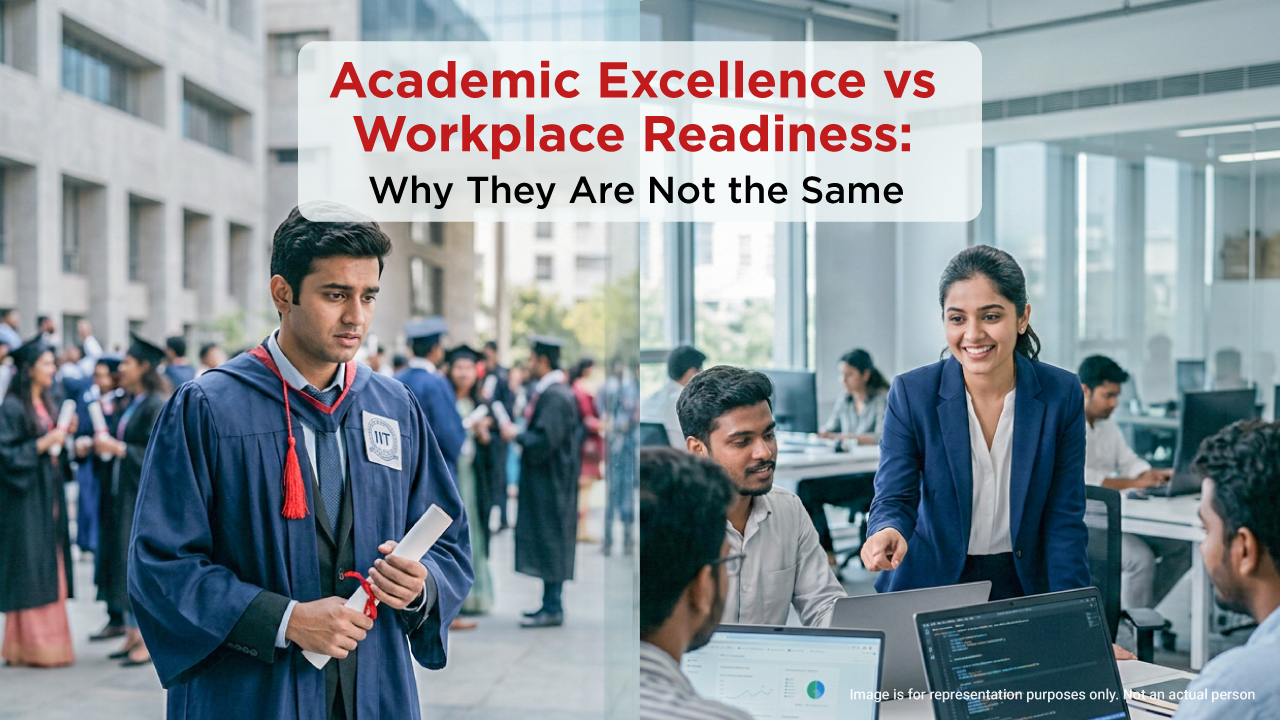
After years of dedication and effort, a student walks across the stage to receive a degree. The achievement is significant, the recognition is well-earned, and the future appears full of promise. Yet, for many graduates, the transition into the workplace reveals an unexpected challenge. Despite strong academic performance, adapting to professional environments often proves difficult. This is not a question of intelligence or effort, but a reflection of a deeper gap between academic success and workplace readiness.
For decades, education systems have measured achievement through structured evaluation. Exams, grades, and theoretical understanding have defined success. Students who perform well within this system develop discipline, analytical thinking, and the ability to master complex concepts. However, the demands of the workplace operate on an entirely different set of expectations.
Workplace Challenges: Beyond the Classroom
Professional environments are rarely structured around clearly defined problems with predictable answers. Instead, employees encounter ambiguity, shifting priorities, and interconnected challenges. They must collaborate across teams, communicate ideas effectively, and make decisions even when information is incomplete.
This is where the gap between academic achievement and workplace readiness becomes evident. A graduate who excels in independent, theoretical work may struggle in environments that demand collaboration, adaptability, and real-time problem-solving. Skills such as communication, flexibility, and time management become as important as technical knowledge.
Workplace success requires the ability to navigate complexity rather than simply solve predefined problems.
How Success Is Measured: School vs Work
In academic settings, success is typically measured through individual performance in examinations and assignments. In contrast, workplace performance is evaluated based on collective outcomes and impact. Success often depends on how effectively individuals contribute to teams, manage relationships, and support broader organizational goals.
Employers increasingly recognize this distinction. While academic qualifications remain valuable indicators of foundational knowledge, they are no longer sufficient on their own. Organizations now prioritize skills such as critical thinking, collaboration, problem-solving, and adaptability-capabilities that enable individuals to apply knowledge in practical contexts.
This shift highlights the need for a more comprehensive approach to preparing individuals for professional environments.
Experiential Learning Initiatives in Modern Education
Educational institutions are beginning to respond to this challenge by integrating experiential learning into their programs. Internships, live projects, industry collaborations, and project-based learning provide students with opportunities to apply theoretical knowledge in real-world contexts.
Through these experiences, learners develop practical skills that cannot be fully cultivated through traditional classroom methods. Working on real projects requires communication with stakeholders, adherence to deadlines, and the ability to adapt ideas based on feedback. These experiences build confidence and prepare students for the uncertainties of professional life.
As industries evolve rapidly, the ability to learn continuously and adapt becomes increasingly important. Academic knowledge provides a strong foundation, but it must be complemented by practical experience.
Academic Excellence Still Matters
Despite these shifts, academic excellence remains essential. It fosters intellectual curiosity, discipline, and the ability to think critically-qualities that are valuable in any profession. The challenge is not to replace academic achievement, but to extend it by integrating opportunities for applied learning.
When education systems combine theoretical rigor with practical skill development, graduates are better equipped to transition into professional roles. They bring not only knowledge but also the confidence and capability to apply it effectively.
VMI Collective India's Role in Bridging the Gap
Organizations play a critical role in closing the gap between education and workplace readiness. VMI Collective India supports this transition by promoting competency-based learning and skill-focused assessment systems. By aligning educational outcomes with industry expectations, VMI helps create pathways where academic knowledge translates into measurable capabilities.
Through its work in competency frameworks, assessment design, and industry collaboration, VMI Collective India enables institutions to evaluate individuals based on both knowledge and application. This approach strengthens the connection between education and employment, ensuring that graduates are prepared to meet real-world demands.
As the future of work continues to evolve, bridging the gap between academic excellence and workplace readiness will remain essential. Collaboration between educators, industry leaders, and skill development systems will be key to preparing individuals who are not only knowledgeable but also capable of thriving in complex, dynamic environments.