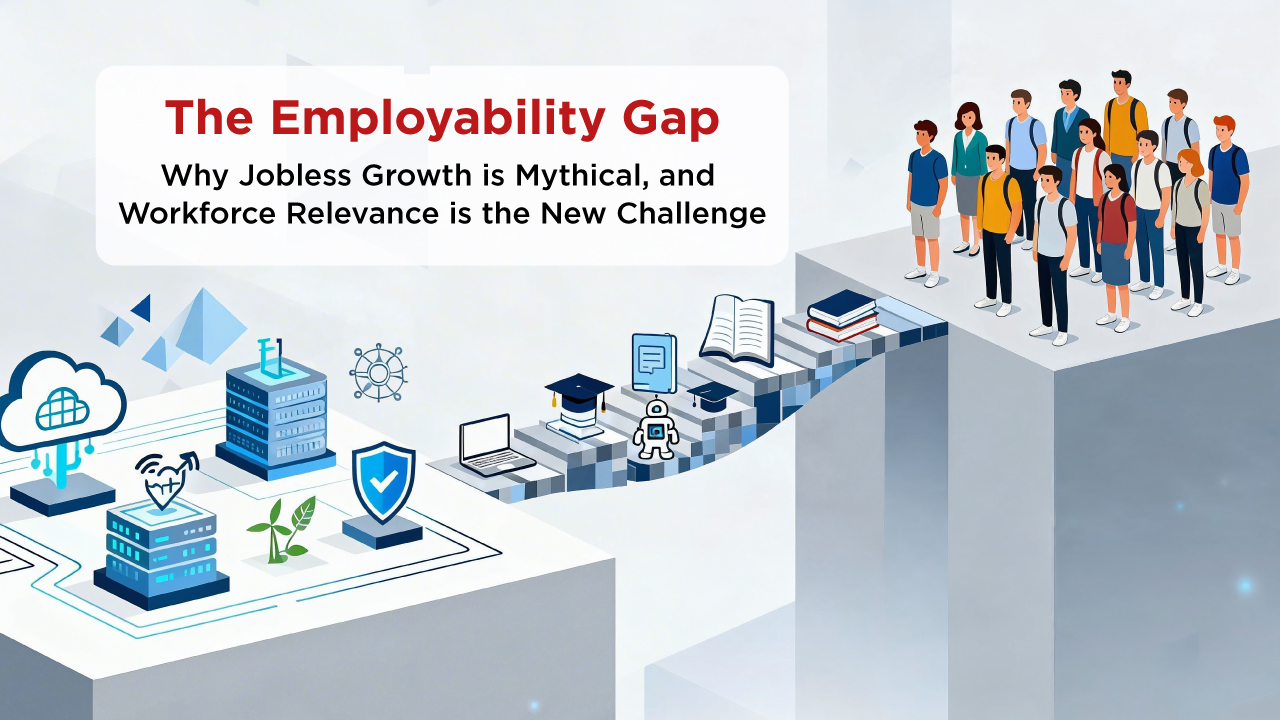
India is often described as a nation experiencing jobless growth, a phrase widely used in policy discussions and media narratives. However, this interpretation oversimplifies a far more complex reality. The economy is generating jobs, industries are expanding, and new roles are emerging across sectors. The real challenge lies not in job availability but in employability-the mismatch between workforce skills and industry requirements.
As businesses evolve and technologies advance, the gap between what employers need and what job seekers offer continues to widen. Addressing this gap requires coordinated efforts between industry, education, and policy frameworks to ensure that workforce readiness keeps pace with economic growth.
The Growing Economy and Workforce Preparedness in India
India’s expanding economy consistently generates opportunities across sectors. Fields such as data analytics, cybersecurity, cloud computing, logistics, healthcare, and renewable energy are witnessing strong demand for skilled professionals. Even traditional sectors like construction, agriculture, and retail are becoming increasingly technology-driven.
Despite this growth, many job seekers-particularly in smaller cities-lack access to quality training and real-world experience. This highlights a critical imbalance: economic expansion is accelerating faster than workforce preparedness, creating the illusion of job scarcity when the real issue is skill misalignment.
The Workforce Relevance Gap in India’s Labor Market
The perceived job crisis is, in reality, a relevance gap. Education and training systems have not kept pace with rapidly changing industry demands. As businesses adopt automation, artificial intelligence, and data-driven technologies, many learning programs remain outdated and heavily theory-based.
Employers today prioritize practical skills, adaptability, and problem-solving ability over theoretical knowledge alone. Certifications without real-world competence no longer meet industry expectations. This shift underscores the need for hands-on learning, digital literacy, and workplace readiness.
Why Traditional Education Models Are Falling Behind
A significant number of graduates enter the workforce each year, but many are not job-ready. Traditional education systems often emphasize academic performance over applied skills, leaving graduates unprepared for real-world challenges.
To remain competitive, education must evolve to include internships, industry collaborations, and experiential learning. Encouraging entrepreneurship and innovation can also empower individuals to create opportunities rather than rely solely on traditional employment pathways.
Opportunities for a Future-Ready Workforce in India
India holds immense potential to transform its employability challenge into a strategic advantage. With a young, dynamic, and adaptable population, the country is well-positioned to become a global talent hub.
By aligning education with industry needs, investing in continuous skill development, and fostering practical learning environments, India can build a workforce capable of meeting future demands and driving sustainable economic growth.
The Role of Industry Collaboration in Bridging the Gap
Collaboration between industry, educational institutions, and training organizations is essential to close the employability gap. Employers must play an active role in shaping curricula, while institutions must prioritize real-world application over theoretical instruction.
Workplace simulations, live projects, and structured internships can significantly enhance job readiness. At the same time, organizations must invest in ongoing upskilling to ensure employees remain relevant in a rapidly evolving job market.
Driving Workforce Transformation Through Strategic Initiatives
Organizations like VMI Collective India are working to bridge the gap between workforce potential and industry requirements. By redesigning talent development strategies, enabling practical training, and aligning skill-building initiatives with market needs, they help create a pipeline of job-ready professionals.
This approach transforms economic growth into inclusive and sustainable employment. It reinforces the idea that the issue is not a lack of jobs but a need for a workforce prepared to seize emerging opportunities.
As India continues to grow, the focus must shift from questioning job availability to improving workforce relevance. By prioritizing skills, adaptability, and continuous learning, the country can unlock its full economic potential and ensure long-term prosperity.
| Key Insights | What It Means for Businesses |
|---|---|
| The real issue is employability, not job availability | India’s economy continues to generate jobs, but many candidates lack the practical skills required to fill these roles effectively. |
| Economic growth is creating new skill demands | Emerging industries require specialized, adaptable, and continuously evolving skill sets. |
| Education must align with industry needs | Practical learning, internships, and employer-driven curricula are essential for job readiness. |
| Workforce relevance depends on adaptability | Employers prioritize hands-on skills, digital literacy, and problem-solving over theoretical knowledge. |
| Collaboration can turn the gap into opportunity | Industry partnerships can build a future-ready workforce and convert economic growth into sustainable employment. |
FAQs
1. What does “jobless growth” mean in India?
It refers to the perception that economic growth does not create enough jobs. In reality, the issue is often a mismatch between available jobs and the skills of job seekers.
2. Why is there an employability gap in India?
The gap exists because many education systems focus on theory rather than practical skills, while industries demand job-ready candidates with real-world experience.
3. Which sectors are creating the most job opportunities?
Technology-driven sectors such as data analytics, cybersecurity, healthcare, renewable energy, and logistics are leading job creation in India.
4. How can the employability gap be reduced?
Through collaboration between industry and education, practical training, internships, and continuous workforce upskilling aligned with market needs.
5. What skills will be most important by 2030?
Adaptability, digital literacy, critical thinking, and lifelong learning will be essential as automation and AI reshape the workforce.