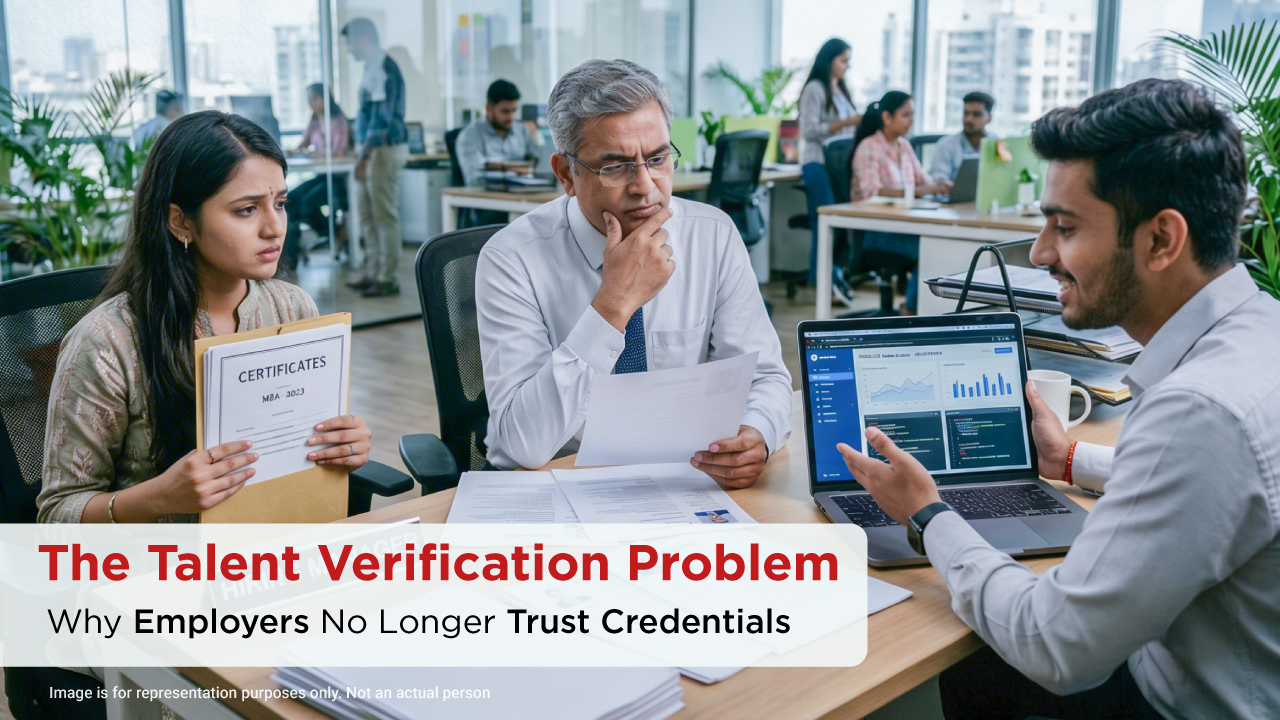
A hiring manager sits at a desk reviewing a long list of applications. The resumes are impressive, filled with degrees from recognized institutions, certifications from popular platforms, and a wide range of claimed skills. On paper, many candidates appear equally qualified. Yet experience has revealed a difficult truth: credentials rarely show what a person can actually do.
For decades, degrees and certifications were trusted indicators of competence. They offered employers a convenient way to evaluate candidates. If someone had completed the right program, it was assumed they possessed the necessary skills. But the nature of work has changed dramatically, and with it, the reliability of credentials.
In today’s dynamic environment, employers are increasingly questioning whether qualifications alone can represent real capability.
Online Learning & the Rise of Alternative Credentials
Access to knowledge has expanded significantly through online courses, tutorials, and digital platforms. While this has opened opportunities for millions, it has also complicated the meaning of credentials. Completing a course no longer guarantees mastery of a skill.
At the same time, industries are evolving rapidly. Technologies, tools, and practices are constantly changing, making previously relevant skills obsolete within a short period. This creates uncertainty for employers trying to assess whether a credential accurately reflects current capability.
This growing challenge is often referred to as the talent verification problem.
The Credentials vs. Competence Gap
Organizations have increasingly observed that credentials do not always predict performance. Some candidates excel academically but struggle in practical situations, while others with fewer formal qualifications demonstrate exceptional real-world problem-solving ability. The gap between what is written on paper and what is demonstrated in practice has become more evident.
As a result, hiring practices are evolving. Employers are shifting toward methods that emphasize applied skills. Candidates are now often asked to complete assignments, present portfolios, or participate in simulations that reflect real work scenarios. These approaches provide deeper insights into how individuals think, collaborate, and adapt.
This shift represents a broader redefinition of talent. Capability is no longer defined by what someone has studied, but by what they can achieve.
Educational institutions are also adapting. Traditional transcripts summarize learning through grades and course titles but fail to capture the full range of acquired skills. In response, new models such as digital portfolios, competency-based credentials, and project-based assessments are gaining importance, allowing individuals to demonstrate tangible outcomes.
Technology’s Role in Solving Talent Verification
Technology is playing a crucial role in addressing the verification challenge. Data-driven assessment systems can measure skills more objectively and consistently. Platforms that track learning progress, project outcomes, and competency development provide a clearer picture of an individual’s abilities.
For organizations, this leads to more accurate talent placement and reduces the risks associated with hiring decisions. It also enables better workforce development by identifying employees ready for new roles or advanced training.
For individuals, transparent skill validation creates more equitable opportunities. When capabilities are measured clearly, talent is recognized based on what people can do rather than where they studied.
As the global economy becomes increasingly skills-driven, reliable talent verification systems will become essential across industries.
Competency Frameworks & Industry Standards: The Way Forward
In this evolving landscape, competency frameworks and skill-based evaluation systems are gaining importance. VMI Collective India supports this transition by helping organizations and institutions build structured approaches to assessing and validating skills.
By focusing on competency mapping, assessment integrity, and alignment with industry standards, VMI enables more transparent and credible talent evaluation systems. This ensures that learning outcomes are measurable and comparable across different contexts.
As the future of work continues to evolve, success will depend on systems where skills are not only developed but also verified with confidence. In such an environment, the true value of talent can be recognized, enabling individuals and organizations to thrive in a capability-driven world.