In a crowded training room, young people sit with notebooks open, listening carefully to instructions on building resumes, preparing for interviews, and adapting to organizational culture. The message is clear and familiar: learn skills to become employable. Yet beneath this structured guidance, something feels incomplete.
Not everyone in that room wants a job. Some want to build something of their own, to create rather than conform, to shape systems instead of fitting into them. But the current skilling ecosystem rarely acknowledges this aspiration. Employment is treated as the default path, while entrepreneurship is seen as a distant possibility.
The Entrepreneurship vs. Employment Mindset in India
For decades, India’s skill development efforts have largely focused on preparing individuals for employment. Training programs emphasize technical knowledge, workplace behavior, and role-specific capabilities. While these are important, they reflect a narrow understanding of success in a rapidly changing world.
Entrepreneurship, on the other hand, is often viewed as risky, uncertain, and secondary, something to pursue only after achieving stability. This mindset has created a gap in how individuals are prepared for the future.
Why Entrepreneurial Skills Matter in a Changing Economy
Today’s economy is driven by innovation, adaptability, and constant disruption. In such an environment, entrepreneurial capability is no longer optional, it is essential. Entrepreneurship is not limited to starting businesses; it is a way of thinking.
It involves identifying problems, taking initiative, making decisions with incomplete information, and navigating uncertainty. These capabilities are relevant not only for founders, but also for freelancers, creators, social innovators, and professionals within organizations.
Challenges Facing Entrepreneurial Skilling in India
Despite its importance, entrepreneurial skilling remains underdeveloped. Many aspiring entrepreneurs are expected to figure things out on their own. They are encouraged to take risks without being taught how to evaluate them, and to embrace failure without understanding how to recover from it.
This lack of structured preparation often leads to burnout, confusion, and self-doubt. Promising ideas fail not because of lack of intent, but because individuals are not equipped with the psychological and strategic tools required to sustain them.
Essential Skills for Aspiring Entrepreneurs
Entrepreneurship demands a different skill set than traditional employment. While employees operate within established systems, entrepreneurs must create those systems from scratch. This requires more than technical expertise.
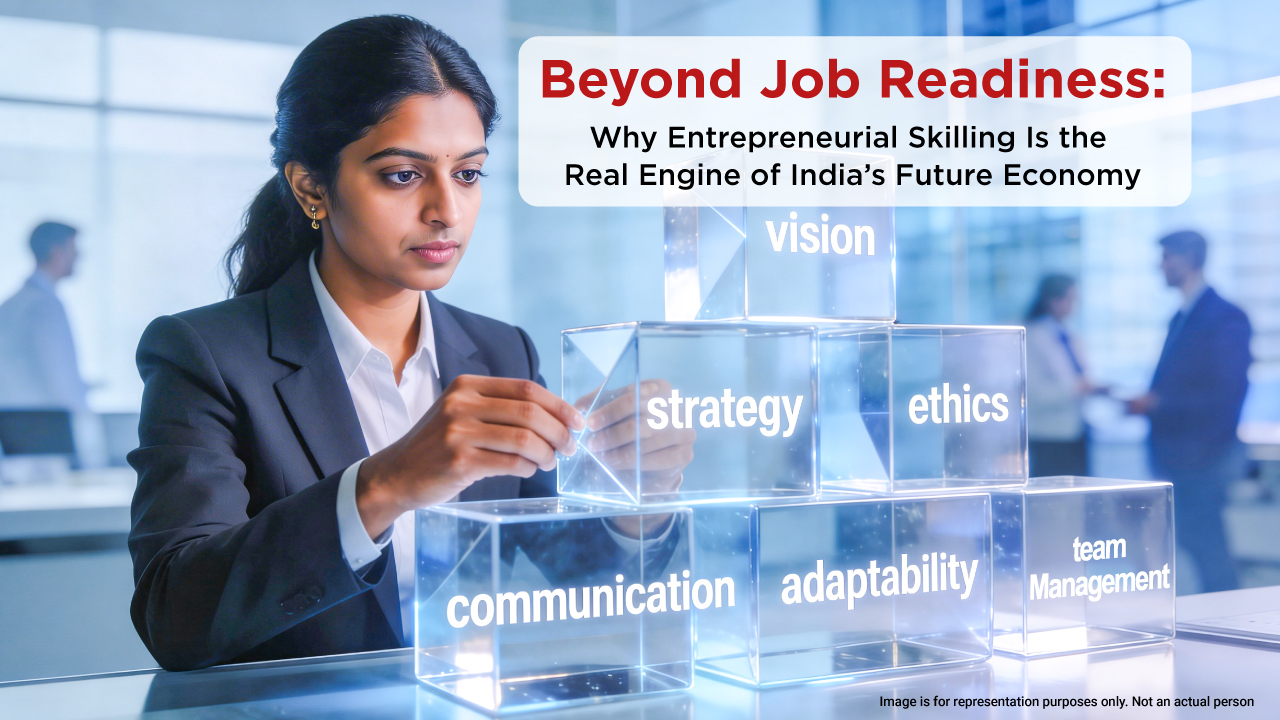
Critical skills include emotional intelligence, self-regulation, ethical decision-making, communication, adaptability, and long-term thinking. These are not optional soft skills, they are essential for survival and growth in uncertain environments.
India’s Demographic Dividend and the Need for Entrepreneurial Skilling
India’s demographic landscape adds urgency to this conversation. With millions entering the workforce each year, it is neither feasible nor necessary to rely solely on traditional employment models. Entrepreneurship, in its many forms, becomes a national imperative.
However, it must be supported with the same seriousness, structure, and scale as job-oriented skilling. Entrepreneurial education should go beyond business plans and pitch decks. It must focus on building resilience, confidence, ethical judgment, and the ability to lead without authority.
When individuals are trained in this way, the outcomes shift. People stop waiting for opportunities and begin creating them. They bring innovation into organizations, contribute to economic growth, and build solutions that address real gaps in the market.
How VMI Collective India Champions Entrepreneurial Skilling
At VMI Collective India, the belief is clear: the future of work cannot be shaped by job preparation alone. Entrepreneurial skilling must be at the core of how individuals are trained for the modern economy.
The organization focuses on developing independent thinkers who can act with clarity, resilience, and responsibility. By combining mindset development, problem-solving, emotional intelligence, and decision-making, VMI prepares learners not just to find opportunities, but to create them.
Its approach recognizes the psychological realities of entrepreneurship, handling pressure, navigating ambiguity, and learning from failure. This ensures that individuals are not only skilled, but also mentally prepared for the challenges they will face.
Through this model, VMI Collective India aims to build a generation defined not by job titles, but by capability. Whether individuals start ventures, lead teams, or innovate within organizations, they carry entrepreneurial thinking with them.
This is not just skilling for employment, it is skilling for agency, dignity, and long-term impact.