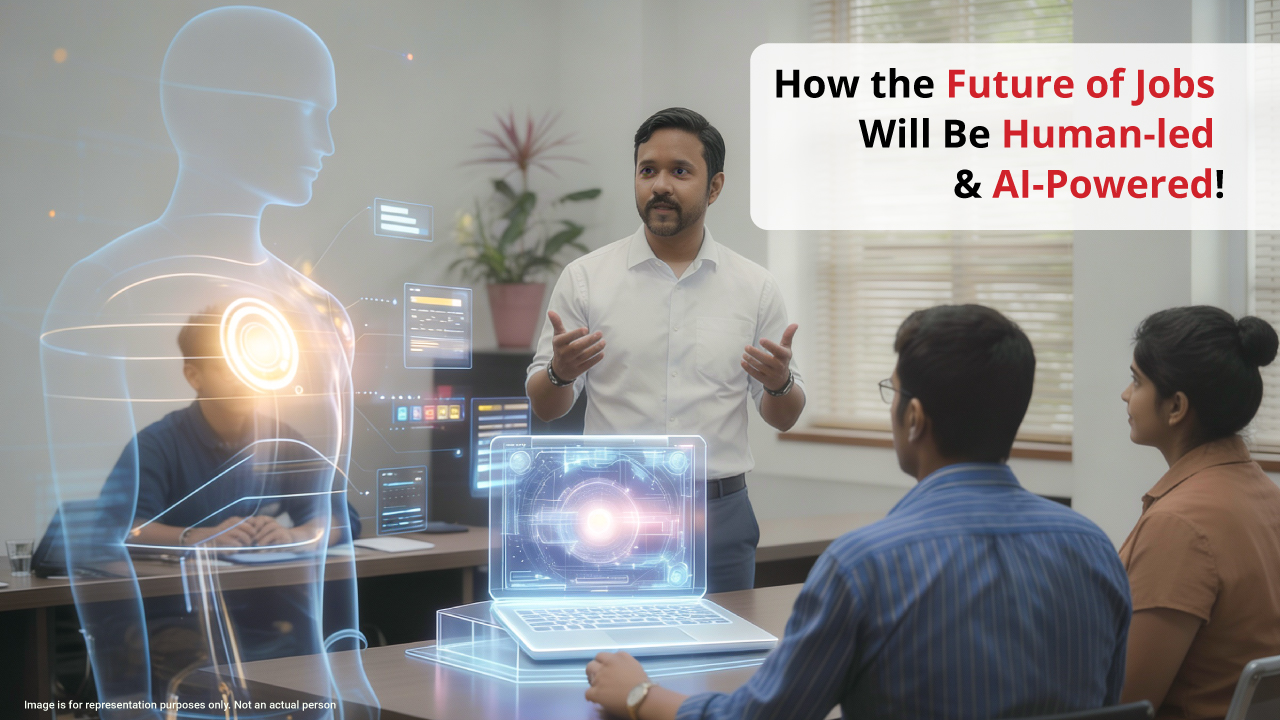
There was no noise but the muffled sound of laptops. Out of curiosity, a young professional looked at the screen, not with fear but with interest. It never occurred to them that AI would replace my job. It was much more optimistic: “How can AI make me a better job performer?” This silent shift in mindset defines the narrative of the future of work.
The Impact of Automation on the Future Workforce: Human and AI Collaboration
AI is no longer a means to substitute labor in offices, studios, hospitals, classes, and factories. It is emerging as a companion that improves judgment, creativity, and decision-making. The marketer does not lose their job to AI; they can analyze consumer behavior within seconds and focus more on narration. A teacher does not vanish; they use AI to make learning more personal and spend more time mentoring students. An ultimate decision is made by a doctor, yet with the assistance of AI that helps recognize patterns that the human eye cannot observe.
Understanding AI Augmentation: Boosting Human Capabilities at Work
Automation removes tasks. The increase in strength is augmented. This distinction is profound since work is not about both productivity and purpose, identity and dignity. Human beings come with context, compassion, morals, and creativity. AI initiates speed, magnitude, and pattern recognition. When these strengths are combined, work is enriched rather than impoverished.
The most useful professionals of tomorrow will not be those who are aware of it all; they are the ones who know how to pose the right questions of AI. They will learn to control intelligent systems, justify their results, use human judgment, and accept responsibility for the consequences. This future means that critical thinking is more significant than memorization. Communication is more important than computation. Innovation is more critical than monotony.
Human Expertise & AI: The Evolving Role of Intuition, Strategy, and Problem-Solving
This change also requires a new learning mentality. Careers will not be a ladder but a developmental process. These skills need constant updating, not every decade but every few years or more often. Employability will be characterized by the capacity to learn, unlearn, and relearn, rather than by a single qualification. Meanwhile, this future may be crushing. Most individuals are on the brink of this change, questioning whether they fit in. The answer is yes, but only when learning is made available, applicable, and very human.
How VMI Collective India Prepares Professionals for an AI-Augmented Future
This is where organizations such as VMI Collective India come into play, not as an out-of-town training provider but as a partner in change. VMI Collective India has focused on equipping people for an AI-augmented future, making them the primary unit of learning. Rather than learning how AI can substitute for human work, it focuses on how AI can enhance thinking, leadership, creativity, and decision-making. Students are trained to view technology not as an adversary but as a partner.
VMI Collective India can help professionals and students build confidence and competence through industry-aligned programs, real-world projects, and reflective learning experiences. It fosters capabilities that can be easily imitated by machines, such as ethical judgment, teamwork, communication, and purpose-oriented leadership, and develops proficiency in the use of modern tools. In a world informed by intelligent systems, the work of VMI Collective India has been to remind people of something fundamental: technology can dynamically alter the way we work, but it is people who will always determine why we work.
| Key Insight | Explanation |
|---|---|
| Human-AI Collaboration Will Define the Future Workplace | AI will increasingly work alongside humans rather than replacing them, enabling professionals to make better decisions, analyze data faster, and focus on strategic and creative tasks. |
| AI Augmentation Enhances Human Capabilities | Automation removes repetitive tasks while AI augmentation strengthens human judgment, creativity, and problem-solving abilities. |
| Future Professionals Must Learn to Work With AI | Success will depend on the ability to ask the right questions, interpret AI insights, and combine human judgment with machine intelligence. |
| Lifelong Learning Will Define Employability | Careers will evolve continuously, requiring professionals to learn, unlearn, and relearn new skills throughout their working lives. |
| Human Skills Will Remain Essential in the AI Era | Capabilities such as empathy, leadership, communication, and ethical judgment will become even more valuable as technology advances. |
FAQs
1. Will AI replace human jobs in the future?
AI is more likely to augment human work rather than replace it completely. Many jobs will evolve to combine human creativity, judgment, and communication with AI-powered data analysis and automation.
2. What is AI augmentation in the workplace?
AI augmentation refers to the use of artificial intelligence to enhance human capabilities. Instead of replacing workers, AI supports decision-making, improves productivity, and enables professionals to focus on higher-value tasks.
3. What skills will be most important in the AI-driven future of work?
Critical thinking, creativity, communication, leadership, and the ability to work with AI technologies will become essential skills for professionals in the evolving job market.
4. How can professionals prepare for AI-powered workplaces?
Professionals can prepare by developing digital literacy, learning how AI systems work, improving problem-solving abilities, and committing to continuous learning.
5. Why is human expertise still important in an AI-powered future?
Human expertise provides context, empathy, ethical reasoning, and strategic thinking that machines cannot replicate, making human judgment essential even in highly automated environments.