Thousands of students enter classrooms every day across the country. They come with notebooks, laptops, and expectations based on the years of schooling. The lecture is introduced, slides are displayed, and ideas are described in detail. Students attend classes, take notes, and study to prepare for tests that will determine their grades. The system is predictable, familiar, and organized. But somewhere outside the classroom, the world of work is evolving at a pace beyond the reach of traditional education.
The industries are no longer run on a slow cycle. Technologies change every few months, business models change fast, and organizations keep adapting to the new realities. Knowledge alone will hardly suffice in such an environment. The only thing that really matters is that one can use the knowledge to resolve issues, formulate solutions, collaborate in groups, and cope with new challenges. Employers are increasingly seeking those who can demonstrate these skills, rather than merely defining them.
This widening gap between learning and doing is silently transforming the debate on higher education. Universities have been places of intellectual exploration, where ideas are learned, discussed, and understood. In the contemporary economy, knowledge of a concept is not the end in itself. The practical question is whether students can convert theory into something useful.
Reimagining University Spaces as Skills Labs
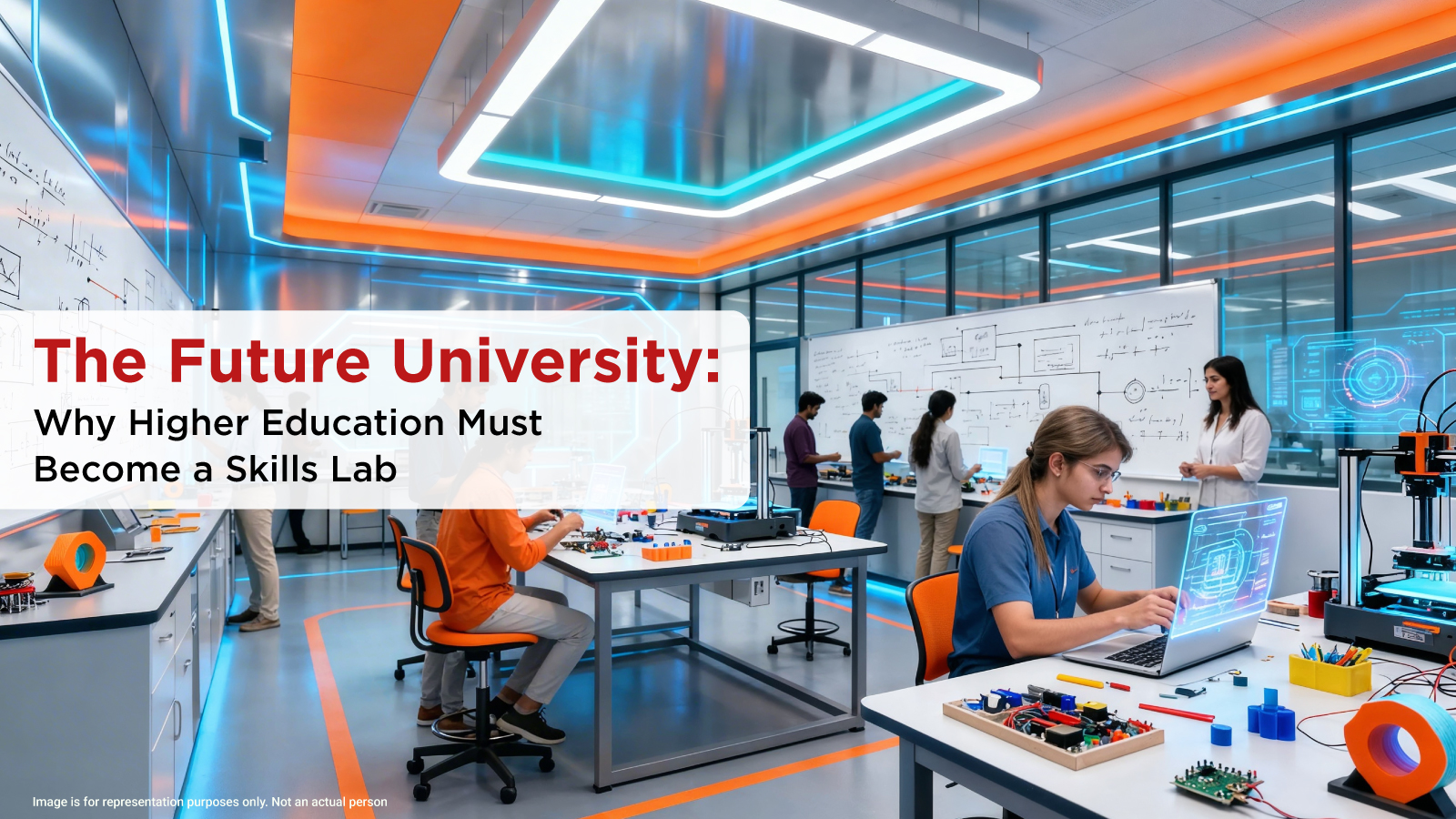
Consider a university where the learning rooms are more like artistic studios than lecture rooms. Rather than simply studying to take exams, students are exposed to live industry- and society-based challenges. A marketing student constructs a campaign for a local business. A technology student will develop a prototype to solve a problem on the ground. A policy major investigates a community problem and gives practical solutions. Studying is both hands-on and participatory, and in touch with the world beyond campus.
There is no fear of failure, as failure is seen as part of the learning process in such an environment. The learners experiment, develop, and use another attempt. The professors, as well as practitioners who know how these ideas operate in the real world, provide them with feedback. Gradually, students start creating something even more valuable than grades: the capability.
This is what the so-called skills lab model of higher education entails. The skills lab is not an alternative to academic learning; it complements it by turning knowledge into skills. The ideas learned in the classroom would be used to conduct real-life experiments. The theory is meaningful when students can observe how it affects decisions, outcomes, and the real lives of real people.
Project-Based Learning: A Global Trend
The transition to this model has already begun in other regions of the globe. Universities are experimenting with project-based learning, interdisciplinary courses, and industry partnerships. Students should create portfolios of what they have created, solved, or enhanced. A body of work tells the story of a student rather than having a single exam determine success.
This movement also indicates a better understanding of people's actual learning process. Practice, reflection, and iteration are the ways skills are developed. Students, when exposed to real problems, find themselves in a state of ambiguity and complexity, which cannot be reproduced in textbooks. Such experiences develop resiliency, critical thinking, and creativity, all of which are becoming increasingly required in modern workplaces.
Why India Needs Skills-Based Higher Education
In the case of India, this change is particularly important to accept. The number of youths in the country is among the highest in the world, and the country graduates millions of youths annually. It is not merely about increasing access to a particular education, but about whether education equips students with the skills important in professional life. Making universities places where students learn through building, testing, and solving would unleash massive potential.
In the college of tomorrow, the campus is more than a learning institution; it is a living laboratory of concepts. The students do not just graduate with knowledge; they also demonstrate what they are capable of doing. Their transcripts cannot be heard as loudly as their portfolios, projects, and proven skills.
VMI Collective India: Driving Skills-Based Education Reform
In this dynamic environment, the organizations that connect the worlds of learning and practical ability are gaining increasing significance. VMI Collective India is moving towards this vision through assisting in the creation of systems that appreciate demonstrable abilities and applied learning. The organization helps create an environment where students can transcend passive learning and engage in active creation by sponsoring structures that connect education to practical capability development.
The focus of its initiatives lies in practical application, interdisciplinary investigation, and the development of competencies in accordance with international professional standards. Partnership and ecosystems will be important as universities redefine their place in an ever-changing world. The university, in that future, is something far more than a place of teaching; it is a place to turn potential into reality.