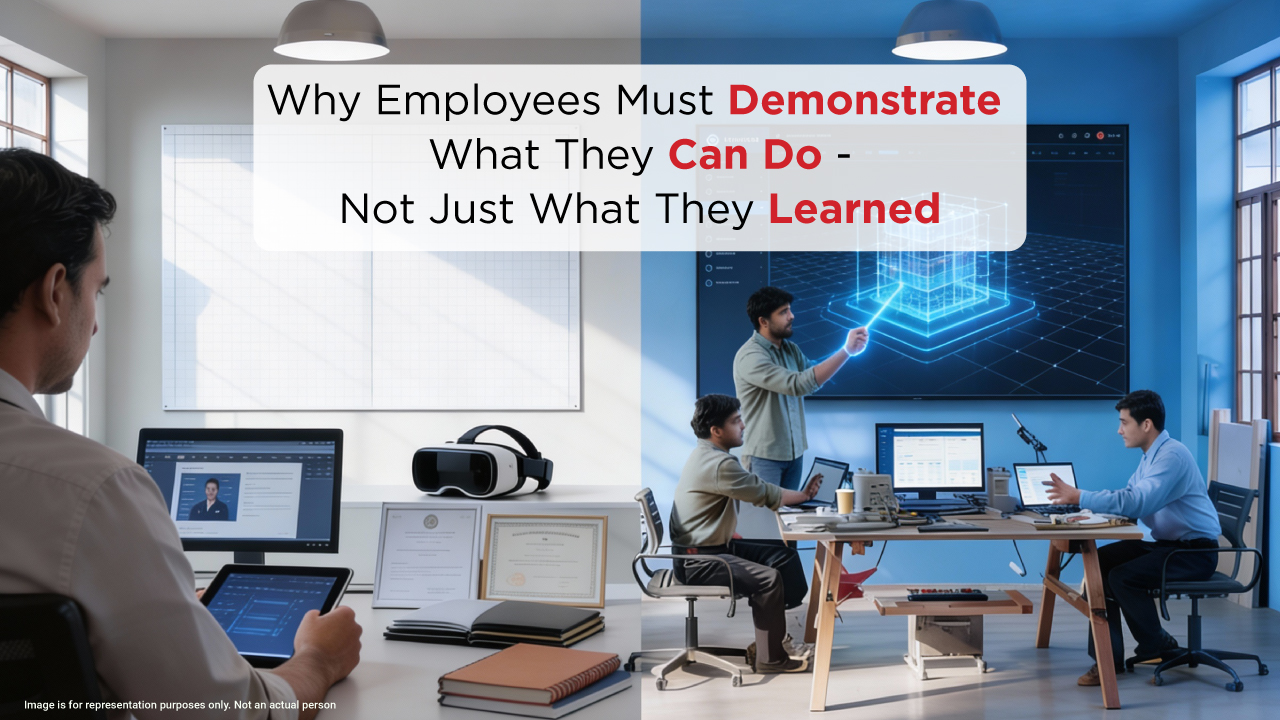
Workplaces in India are changing rapidly. Over the past decade, this shift has accelerated, pushing both employers and employees to rethink what workplace effectiveness truly means. Across industries, including technology, manufacturing, logistics, retail, finance, and creative sectors, employers now focus on whether individuals can perform on the job, not merely attend training or pass examinations.
Simply completing courses or earning certificates no longer proves job readiness. Organisations increasingly value employees who can translate learning into real-world results that actually impact the business. Today, being productive, adaptable, and performance-driven matters more than participation alone. Employees are expected to keep learning and demonstrate applied skills through projects, challenges, and measurable contributions to their teams. This shift means that professional growth is tied directly to showing value in real work situations, not just theory or attendance.
Employees must show what they can do, not just what they know. This shift is driven by three major forces: changing job roles, rapid technological advancement, and rising employer expectations. Modern roles demand both technical expertise and soft skills, often extending beyond traditional job descriptions.
Technology evolves so quickly that yesterday’s tools may be irrelevant tomorrow. As a result, professionals who can learn continuously and apply knowledge effectively remain valuable. Employers now look for visible outcomes, not just effort or intent.
The Complexities of Workforce Readiness in India
First, job roles are increasingly cross-functional and complex. For example, a software professional may need to understand customer experience and business goals, a sales executive must be comfortable with data, analytics, and digital tools, and a factory operator may work with digital dashboards and automation technology. Teams now often consist of people from different backgrounds collaborating on projects that require a broad set of technical and soft skills. Learning in isolation does not prepare employees for this interconnected reality; application does.
Second, technological change is outpacing traditional training models. Employees who consistently demonstrate competence through hands-on work, projects, and deliverables stay relevant even as tools and systems change.
Third, organisations operate in high-pressure, competitive environments. They need teams that can deliver reliable performance from day one. When employees demonstrate their skills, onboarding speeds up, confidence increases, and output quality improves.
Embracing Change: Building a Future-Ready Workforce
For employees, this shift represents a powerful opportunity. Professionals who build real-world, transferable skills can move across companies, industries, and even international markets. Those who focus on performance proof often emerge as leaders.
By showcasing portfolios, project outcomes, performance metrics, and real contributions, employees can earn promotions, expand responsibilities, and access global opportunities. Demonstrated capability becomes a career asset, building credibility and opening doors.
This approach also fosters a growth mindset, encouraging continuous improvement, feedback, and excellence. It builds resilience, adaptability, and the ability to respond constructively to setbacks, all of which are critical in today’s fast-changing work environment. As competition intensifies, individuals with proven results stand out in both the Indian and global job markets, giving them a clear advantage in pursuing new roles and advancing their careers.
Many Indian professionals, especially at the entry level, struggle not because they lack knowledge, but because they lack hands-on experience. Opportunities to apply learning in real-world situations are often limited early in careers. Integrating demonstration-based learning into training, onboarding, and career development can significantly improve workforce capability.
Organisations can support this shift through apprenticeships, mentorship programs, live projects, and task-based assignments. Offering employees opportunities to regularly present and reflect on what they’ve achieved reinforces skill development and boosts motivation. Over time, this builds confidence, independence, and adaptability. By combining learning with doing, companies ensure theory is always reinforced by practice, leading to sustainable performance and growth. This culture of active demonstration also makes it easier to spot and nurture emerging talent within the organisation.
VMI Collective India’s Role in Advancing Workforce Readiness
VMI Collective India is at the forefront of enabling a performance-oriented workforce. We help organisations clearly define role-specific skills, design task-based assessments, and implement evidence-driven talent development models.
By redesigning training to include simulations, practical exercises, workplace projects, and skill demonstrations, VMI ensures that learning leads to measurable outcomes. This approach allows employees to build credible proof of capability rather than just certificates.
At the organisational level, it helps Indian companies build agile, future-ready, and globally competitive teams. By shifting the focus from learning completion to performance demonstration, we support a workforce prepared to meet today's demands and tomorrow's uncertainties.
| Key Insight | What It Means |
|---|---|
| Workplace value now depends on demonstrated performance | Employers increasingly prioritize employees who can apply knowledge to real tasks and deliver measurable outcomes rather than those who only complete training programs. |
| Job roles are becoming more cross-functional and complex | Modern professionals must combine technical skills with business awareness, communication, and adaptability to work effectively across teams and projects. |
| Continuous learning must be paired with practical application | As technology evolves rapidly, employees remain relevant by consistently applying new knowledge through projects, problem-solving, and real workplace contributions. |
| Evidence of capability strengthens career growth | Portfolios, performance metrics, project outcomes, and real achievements help professionals build credibility and unlock new career opportunities. |
| Organizations must integrate demonstration-based learning | Apprenticeships, mentorship programs, simulations, and live projects help employees translate theory into practice and build a future-ready workforce. |
FAQs
1. Why are employers focusing more on demonstrated skills rather than certificates?
Employers now prioritize employees who can apply their knowledge to real-world situations and deliver measurable results. Certificates may indicate course completion, but do not always demonstrate practical ability. Demonstrated skills through projects and performance provide stronger evidence of job readiness.
2. How can employees demonstrate their skills effectively?
Employees can demonstrate skills through real projects, measurable outcomes, performance metrics, and professional portfolios. Participating in live assignments, problem-solving tasks, and collaborative work also shows how well they apply knowledge in practical settings.
3. What role do organisations play in promoting demonstration-based learning?
Organisations can support this shift by introducing apprenticeships, mentorship programs, simulations, and task-based training. These approaches let employees practice skills in real scenarios and build confidence through continuous feedback and practical experience.
4. How does demonstration-based learning benefit career growth?
When professionals showcase real contributions and results, they build credibility and trust within their organisations. This often leads to greater responsibilities, leadership opportunities, and stronger prospects for advancement in local and global job markets.
5. How will workforce training evolve by 2030?
By 2030, workforce training will increasingly focus on hands-on projects, real-world simulations, and performance-based assessments. Employers will evaluate employees based on their ability to solve problems, adapt to new technologies, and demonstrate continuous improvement.