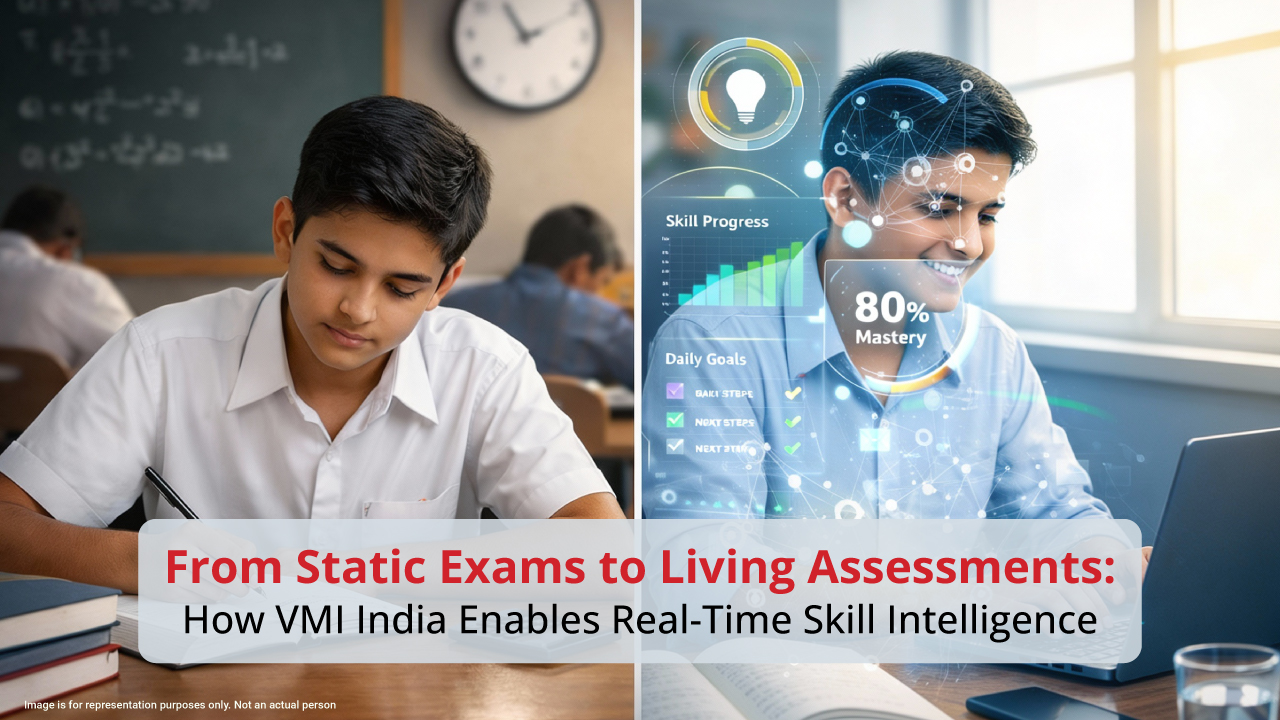
Rajesh was in the 10th standard when he realised that examinations had started to creep in and slowly define his self-esteem. A three-hour paper determined his perception of himself over the weeks. The teachers rushed through the chapters in accordance with the syllabus, leaving unresolved queries. Like millions of learners studying under the CBSE and using NCERT-recommended textbooks, Rajesh was learning, though not necessarily gaining real-world intelligence.
The education system in India has been based on unchanging exams: an unchanging syllabus, an unchanging schedule, and unchanging results. They do not assess growth over time; rather, they assess it at a single point. But students in Classes 9–12 are not mature students. Their self-confidence is unstable, their interests change, and their clarity of ideas develops asymmetrically. This is too much to cover in one exam.
Here, the concept of living assessments comes into play.
Learning That Listens
A living assessment does not hold till the termination of a term. It does not speak but listens as learning occurs. When Rajesh cannot solve quadratic equations in Class 9, the system picks up patterns, not of simple mistakes, but of trying and trying again, and partial comprehension. As soon as he gets better, the improvement is noted.
This is possible through AI-based evaluation. They work in the background, align with the curriculum goals, and provide real-time information on how a student is learning. Rather than asking, “How much did you score,” the question becomes, “What do you know, and what do you need next.”
This is dramatic for the students undergoing board examinations. When there are no surprises, there is less anxiety. Learning becomes a process of feedback and correction rather than a process of stress and judgment.
NEP 2020 & the Push for Competency-Based Learning
This issue is well identified in the National Education Policy (NEP) 2020. It demands shifting from rote learning and high-stakes examinations to competency-based education. It emphasises formative assessment, critical thinking, and holistic development, particularly during the secondary school years.
But only seeing is inadequate. To be successful in NEP 2020 at the class and school levels, educators must have tools to scale and operationalise continuous, low-pressure assessment. This role is unique in that it involves AI-driven living assessments. They enable schools to monitor competencies over time, personalise learning, and minimise reliance on final exams, which is precisely what NEP 2020 envisions.
This alignment is essential in Classes 9 to 12, as students move from foundational learning to future directions.
Moving Beyond Marks: The Student Perspective
A student's day is already busy: school, homework, tuition, revision, and expectations. A conventional exam can be a stressful element with no explanation. Living assessments are incorporated into regular learning rather than disrupting it. Assessment can be a short diagnostic quiz, an adaptive practice set, or a reflective task without the fear that the term test carries.
Over time, students begin to perceive assessments as reflections rather than rulings. They recognise their weaknesses and strengths early. A student who is analytically minded is further motivated, while another who struggles conceptually receives support before confidence declines.
Such real-time skill intelligence becomes particularly relevant as students move toward tertiary education under UGC regulation, where practical learning and interdisciplinary thinking are becoming more important.
Teachers as Guides, Not Gatekeepers
Teachers also evolve with living assessments. Instead of spending hours designing exam papers and reviewing them after the fact, educators receive actionable insights while learning is happening. They understand which topics require reinforcement and which students are ready to move forward.
This support becomes invaluable in senior classes where syllabus pressure is intense. Teachers can focus on mentoring, discussion, and conceptual clarity, exactly what NEP 2020 encourages, rather than functioning solely as evaluators.
Preparing for Exams in the Age of Living Assessments
Students moving from Class 9 to Class 12 are not only preparing for board examinations. They are making important decisions about streams, degrees, and careers. Living assessments allow these decisions to be informed rather than forced. They reveal aptitude, interests, and progress over time instead of judging students based on a single stressful moment.
Learning becomes more humane when it is assessed intelligently and continuously.
VMI India: Powering Real-Time Skill Intelligence
This is where VMI India plays a transformative role. By bringing the vision of NEP 2020 to life, VMI India acts as a continuous learning companion aligned with the CBSE and NCERT curricula and competency-based assessment frameworks. The platform maps real-time skill intelligence through AI-driven evaluation systems that observe how students learn rather than simply measuring how much they score.
For students in Classes 9 to 12, VMI India reduces exam anxiety by replacing surprise judgments with continuous feedback. The platform provides powerful insights without adding extra workload for educators. Schools gain a scalable pathway to implement the NEP 2020 vision of formative assessment and holistic student development.
By moving from stagnant examinations to dynamic assessments, VMI India enables students to grow with confidence, not just to pass board exams but to succeed in lifelong learning.
| Key Insights | Explanation |
|---|---|
| Traditional Exams Capture Performance, Not Growth | Static examinations measure student performance at a single moment in time and often fail to reflect how a student improves and develops deeper understanding. |
| Living Assessments Enable Continuous Learning Feedback | AI-driven assessments track learning patterns in real time, allowing teachers and students to identify gaps and improve learning strategies. |
| Competency-Based Education Requires New Assessment Models | NEP 2020 encourages moving beyond memorization toward evaluating application, understanding, and critical thinking. |
| Real-Time Skill Intelligence Reduces Exam Anxiety | Continuous low-pressure assessments reduce stress by providing early feedback and eliminating surprises during final exams. |
| Technology Empowers Teachers and Personalizes Learning | AI-supported platforms help teachers focus on mentoring while offering personalized insights into student progress. |
FAQs
1. What are living assessments in education?
Living assessments are continuous real-time evaluation systems that track a student’s learning progress instead of relying on a single high-stakes exam.
2. How are living assessments different from traditional exams?
Traditional exams measure performance at a single moment, while living assessments monitor learning continuously through quizzes, tasks, and AI-driven insights.
3. How do living assessments support NEP 2020?
They align with competency-based education by emphasizing skill development, continuous feedback, and critical thinking rather than memorization.
4. How do living assessments benefit students in Classes 9–12?
They help identify learning gaps early, reduce exam stress, and guide students in making informed academic and career decisions.
5. How does VMI India enable real-time skill intelligence?
VMI India uses AI-driven assessment aligned with CBSE and NCERT curricula to monitor learning patterns and provide continuous feedback for students and teachers.