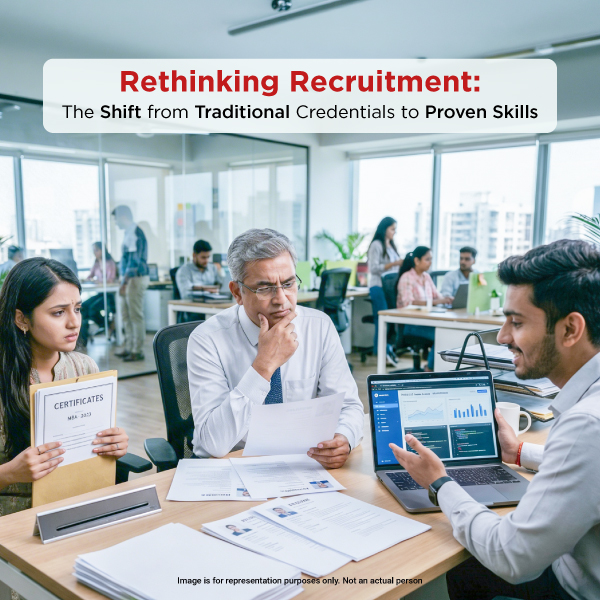
Today’s job market is evolving rapidly, making it increasingly difficult for employers to rely on traditional credentials as proof of talent. While many resumes highlight impressive degrees and certifications, these qualifications do not always reflect a candidate’s ability to perform in real-world situations. The rise of online learning and alternative credentials has expanded access to education, but it has also made it harder for hiring managers to distinguish genuine expertise from surface-level achievements. As a result, organizations are beginning to question whether credentials alone truly indicate capability.
This challenge, often referred to as the talent verification problem, is reshaping recruitment practices. Companies are placing greater emphasis on demonstrated skills rather than academic achievements alone. Work samples, portfolios, and job simulations are becoming key tools in evaluating candidates. Employers want clear evidence that individuals can apply their knowledge effectively, leading to more accurate hiring decisions. At the same time, this shift encourages job seekers to focus on building practical skills and showcasing real outcomes instead of relying solely on certifications.
Technology is accelerating this transformation by enabling more reliable and objective skill assessment methods. Data-driven evaluation tools, digital portfolios, and competency-based testing provide deeper insight into individual capabilities. These approaches help both employers and educators measure and validate skills with greater precision. As these systems gain adoption, recruitment is moving toward a model where what candidates can do matters more than what they have studied, opening opportunities for individuals from diverse educational backgrounds.
VMI Collective India is actively supporting this shift by helping organizations and institutions strengthen talent verification systems. Through the development of competency frameworks and industry-aligned assessments, VMI ensures that learning outcomes translate into measurable, real-world capabilities. By promoting clear and credible skill evaluation standards, VMI Collective India enables both individuals and organizations to succeed in a workforce increasingly defined by capability rather than credentials.
Learn more: Why Employers No Longer Trust Credentials